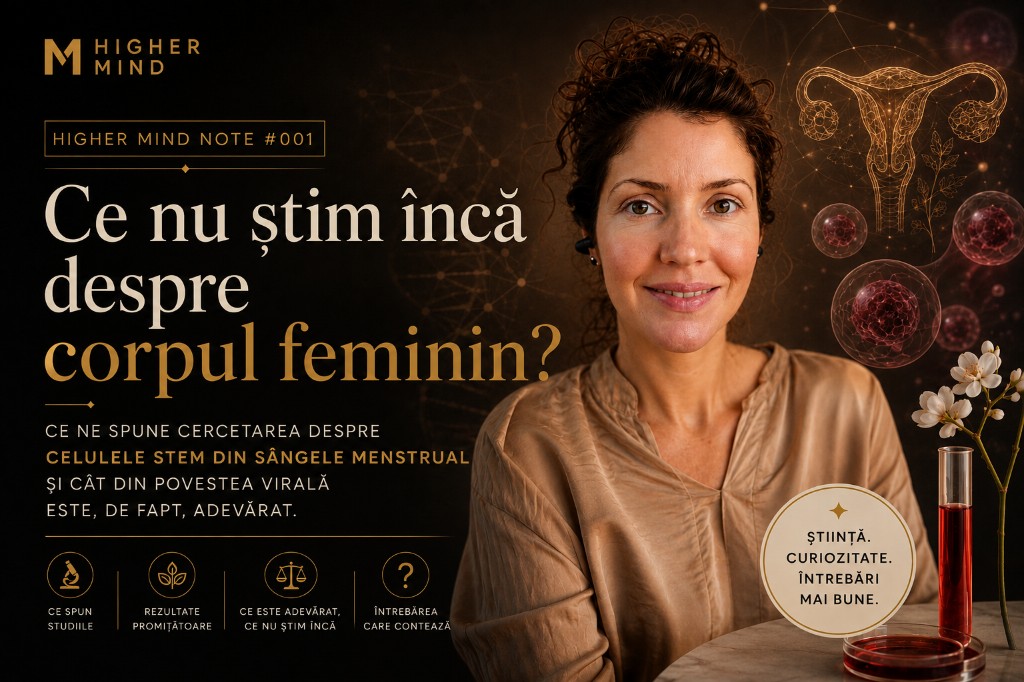
Today I came across a post that claimed something spectacular: that menstrual blood contains stem cells with extraordinary regenerative properties, and that these would be far more effective than those obtained from bone marrow.
My first reaction was: Really?
So I looked up the studies.
And the real story is, in fact, fascinating enough that it does not need the exaggerations of the internet.
What we know
Menstrual blood contains a population of cells known today, in the specialist literature, as menstrual blood-derived stem/stromal cells, abbreviated MenSCs.
They have several characteristics that make them very interesting for regenerative medicine: they can be collected through a non-invasive method, they can multiply rapidly in the laboratory, and they show regenerative and immunomodulatory properties that researchers continue to investigate.
From here, things become even more interesting.
In animal experiments, MenSCs or products derived from them have been studied for wound healing. Researchers observed improved tissue repair and effects on inflammation and the formation of new blood vessels.
In a 2018 study on mice genetically modified to reproduce certain features of Alzheimer’s disease, transplanting these cells was associated with improved memory and learning and with a reduction in some pathological brain changes.
And the research continues. A study published in 2026 compared cells derived from menstrual blood with stromal cells from bone marrow in a rat model of heart failure and found advantages of MenSCs in protection against certain lung injuries.
This does not mean that menstrual blood “cures Alzheimer’s”, repairs human hearts, or that we already have a miracle therapy that medicine has ignored.
Much of this evidence is preclinical — from the laboratory or from animals. Between a promising result in a mouse and a safe, effective treatment for people, there is a very long road.
Nor does the viral claim that these cells are simply “10 times more effective than those from bone marrow” correctly describe the current state of the evidence.
But this is exactly where, for me, the story becomes more interesting.
Because it raises another question.
Menstruation is one of the most ordinary female biological processes. It repeats hundreds of millions of times, in the bodies of women around the world.
And yet something that, until very recently, was viewed almost exclusively as biological waste is today being researched as a possible resource for regenerative medicine.
So the question I was left with is not: “What miraculous powers does menstrual blood have?”
But: how much about the female body do we still not know, simply because we have not asked enough questions about it?
Perhaps this is the most beautiful part of science.
Sometimes progress does not begin with an extraordinary answer.
It begins when someone looks at what everyone considers ordinary and asks:
“But what if it isn’t?”
Higher Mind Note #001